
Conference Presentations
MAGA, Memes, McDonald Trump and the Curated Campaign of Weaponized Victimhood
- International Communication Association National Conference
- June 2025 | Denver, Colorado
- Analysis of Trump-related memes on Truth Social to explore how populist movements construct identity through weaponized victimhood, class imagery, and trolling discourse.
Wild Robot – A Rhetorical Analysis of Postpartum Representation
- Popular Culture Association National Conference
- April 2025 | New Orleans, Louisiana
- Uses rhetorical criticism to examine representations of postpartum experience in the children’s animated film The Wild Robot, drawing connections to maternal mental health, affect, and embodied trauma.
Meming Through Motherhood: Maternal mental health, postpartum depression, and Instagram use for positive outcomes
- Popular Culture Association National Conference
- March 2024 | Chicago, Illinois
- Explores how maternal mental health memes on Instagram foster communal coping and identity work. Focuses on how meme creators use irony, exaggeration, and aesthetics to navigate postpartum depression discourse on Instagram.
Snapshots of U.S. Hegemonic Culture in Memes
- Popular Culture Association National Conference
- August 2022 | Galway, Ireland.
- Examines the trope of FBI agents in popular Internet memes as rhetorical tools to hypernormalize the panopticon surveillance state in the U.S.
An Analysis of Russian Stereotypes in season three of Netflix’s ‘Stranger Things’
- International Conference on Communication and Media Studies: Identity and Power
- August 2020 | London, U.K.
- Identifies anti-Russophone stereotypes using rhetorical analysis of character archetypes and narrative elements in season three of ‘Stranger Things’
Exhibits
Slow Your (Sc)Roll
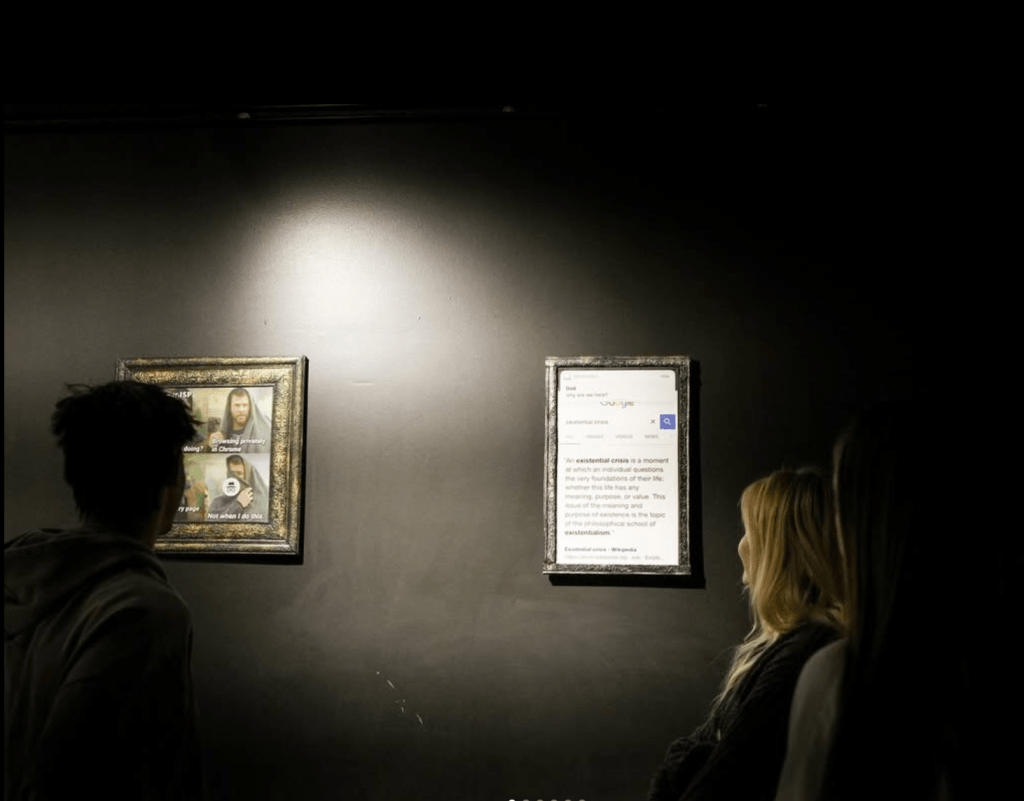
What happens when ephemeral images are pulled out of the feed and into a space that demands pause? Slow Your (Sc)Roll is a physical media exhibit that repositions memes as cultural artifacts—printed, projected, and paused. Designed to interrupt platform logic and reframe viral content as visual discourse, the project asks: what truths—or ideologies—start to surface when memes stop moving?
M.A. Graduate Thesis
Homogenization of Russophones and Russian culture in U.S. media: A case study
This case study examines the homogenization of Russian-speaking individuals in U.S. media and investigates the ideological forces driving that process. Using ideological criticism, it analyzes televised news coverage of the 2013 Boston Marathon bombing across FOX News, CNN, and MSNBC. Reports are categorized by network and coded according to visual and audio content. Each segment is assessed through stereotype frameworks including cultural tropes, anti-Soviet sentiment, linguistic markers, geographic generalizations, non-American identity framing, and Chechen-specific narratives. The study contributes to scholarship on Russian stereotyping in American media by highlighting how such representations are constructed and circulated across political news networks.
 Olga White